Stolen advice
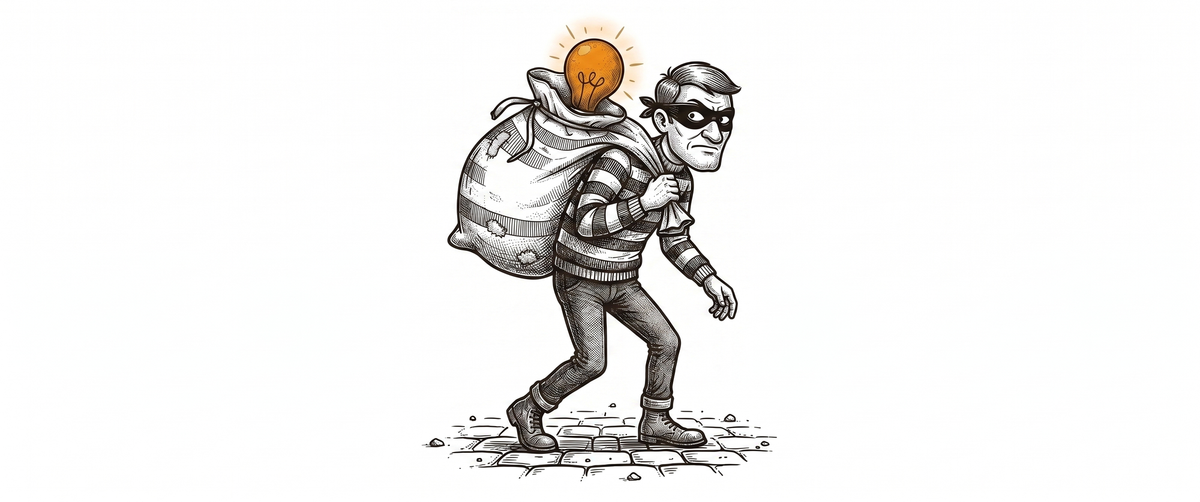
The best advice I ever took was never given to me; I stole it. I recommend you steal it, too.
I was on a call this morning with an old friend who runs a fintech business based out of Oz. It has been nearly a year since I sold Fundipedia, and he was full of questions because he is currently navigating his own scale-up journey.
"How's life now compared to when you were working full time?"
"Have you lost any friends? Made new ones?"
"What does day-to-day life look like now?"
"How's your wife? How's your kid handling the change?"
I gave as many facts as I could, told a few stories, and we laughed at the absurdity of my current reality. The fact is, I get asked for advice more than ever now. Within the last seven days alone, I have been asked to guide a family member through a corporate pivot, talk an associate through an organisational crisis, and audit a peer's market strategy.
I take the responsibility seriously. But the reality is that the baseline advice people ask for is rarely the advice they actually need.
The recent bat signal I accidentally shot into the sky by retiring at forty-two has revealed a fundamental flaw in how people view success. Observers treat the sale of my business as an isolated event. Like a cheat code you activate once to unlock early retirement. Because of this, their questions are entirely transactional. They want a one liner they can implement tomorrow.
But wealth and autonomy are not events. They are the lagging indicators of a deeply ingrained operating system. They are the compounding results of a specific time management and risk mitigation repeated daily over twenty years.
Time management means waking up every day, and doing the nastiest things on your to-do list first. I call this eating the frog - named after the book. Risk mitigation is never making a mistake so big that it kills your business.
When I try to explain this boring reality, people leave disappointed.
They wanted an epiphany.
The best form of advice is stolen advice.
The modern professional needs to look up from their screen and use their eyes and ears in the exact ratio they were provided. We are constantly surrounded by people who are actively out-executing us across finance, health, and relationships. It is not a race, but the people on legitimate winning streaks are shockingly visible if you just look around.
You need to observe these operators with clinical detachment. Dissect their baseline mechanics. Watch how they work, how they communicate, who they spend time with, and what they value. If they own a business, download their filed accounts and read them. If they write online, analyse their essays.
Just as importantly, observe what they reject. Look at what they refuse to say, what they decline to read, and what they choose not to tolerate. The architecture of what a successful operator excludes from their life is far more instructive than what they include. Analyse the outcomes they are optimising for.
I built my own business and career by constructing a mental framework of the successful systems I saw working for others, and then ruthlessly applying those cloned mechanics day in and day out for twenty years. As a tactical bonus, when you observe a high-value target closely over a long period, you also gather the context needed to reach out to them in a way that more or less guarantees a response.
The application of this framework spans from major structural strategies to minor behavioral adjustments. The beauty of stealing a "system" is that you can test it in private; if it fails, you discard it, and if it works, you double down. Nobody will ever know!
System One: The Economics of Availability
One of the most commercially successful operators in my network maintains a state of near-constant availability. I could call him on Christmas Day with a complex operational challenge, and he would happily answer.
Critically, his availability is not the result of a chaotic, reactive schedule; it is the product of a highly restrictive input architecture. He spends zero time on social media. He batches his asynchronous communication, checking his email only three or four times a day. He has a clean mind.
Because he protects his baseline mental bandwidth, he can dedicate his days to high-leverage, face-to-face meetings. When he responds to queries, he does so with unambiguous brevity, entirely confident that his peers will ask for clarification if required. His life is stripped of low-leverage loose ends.
I cloned this communication architecture. By batching inputs and forcing brevity into my outputs, I freed up the exact bandwidth required to scale my own enterprise.
System Two: Physical Discipline
I belong to a flying club where an eighty-year-old instructor still actively trains pilots. He runs five kilometers down the seafront every morning. Similarly, a peer from the fintech sector—a founder who has built an incredible career in technology and finance—maintains the cognitive clarity of an operator half his age through daily, non-negotiable trail running.
Average observers view this as a health hobby. I disagree. I feel that these men maintain rigorous physical output because they understand that high-value cognitive processing requires an optimised physical engine.
I stole this mechanic. While my current training targets half-marathons rather than daily short runs, I treat my thirty-kilometer weekly baseline as a non-negotiable business expense. Physical conditioning is the infrastructure that prevents cognitive decline. It's also true that I have some of my best ideas when running.
System Three: Time management
Subtle, minor thefts compound just as powerfully.
During a dinner with several fintech founders, one of the most successful operators at the table stood up mid-conversation, delivered a brief, cheery farewell, and left the venue immediately to catch a train. There was no awkward lingering, no stalling for "one for the road," and no prolonged, apologetic goodbye. It was a masterclass in clean execution.
Prior to observing this, I routinely struggled with exit boundaries, often resorting to an unnoticed "Irish Goodbye" to escape social fatigue. I stole his mechanic.
Guarding your calendar and your energy isn't rude; it is the baseline requirement for getting things done. Letting an event or a meeting drift past its logical conclusion out of politeness is an act of compliance, not efficiency.
Nice is the compliance people demand from you. Kindness is the structural respect you owe to your own time.
System Four: Skill Stacking
I also recommend stealing from strangers. When reading biographies or analysing successful public figures, you are looking for the structural anomalies that allowed them to win.
In his book How to Fail at Almost Everything and Still Win Big, author Scott Adams outlines the concept of "skill stacking." His thesis is that straining to become the absolute top 1% in a single, hyper-competitive discipline carries a high probability of failure. Instead, the more reliable path to high-value autonomy is to become above-average (the top 25%) at two or more complementary skills.
When you stack those attributes—such as combining intermediate software architecture with exceptional technical sales ability—your unique intersection makes you an statistical rarity. You effectively engineer an unfair market advantage. I observed this compounding mechanic early in my career and used it to bridge the gap between building software and selling it to enterprise. A skill that not many people have.
The framework is simple, but it requires a level of active discipline that most people won't make the time to deploy.
Success isn't an elite club, and doesn't require an invitation. The blueprints are performed in public, every single day, by the people who are no better or more talented than you.
This is great news - because if you look up from your screens and take note of the successful operators around you, you can clone the machine for your own benefit. And nobody will ever know.